
Anki made spaced repetition famous. Lingedia keeps the science but removes the friction, the passiveness, and the mental fatigue.
Table of Contents
Why Anki Feels Right in Theory — But Fails in Practice
For years, polyglots and language nerds have recommended Anki as the “gold standard” for vocabulary learning. They’re not wrong about the core idea: Spaced Repetition (SRS) is the only scientifically proven way to remember words long‑term.
But most learners don’t quit because the science is bad.
They quit because Anki is:
Lingedia was built to fix all three.
Input Problem: Stop Wasting Time Making Cards
To add a new word in Anki, you usually have to stop what you’re doing, open the app, create a card, type definitions, and format everything manually. Or you download a giant pre‑made deck with thousands of irrelevant words. It feels like data entry, not language learning.
Lingedia gives you five effortless ways to capture vocabulary from real content:
- In‑App Browser: Tap any word on any website to translate and save instantly.
- Video Immersion: Tap words in subtitles while watching videos.
- Super Dictionary: Oxford, Collins, and more in one search.
- Smart Curated Lists: Pick only the words you want.
- Copy‑to‑Translate: Copy a word in any app → Lingedia pops up.
Passive Problem: Stop Just Flipping Cards
Anki trains recognition, not usage. You flip cards, but you don’t train speaking, listening, or writing. That’s why many learners can review 100 cards but still freeze in real conversations.
Lingedia replaces flipping with a Smart Quiz that forces real interaction through three active recall exercises:
A. Speaking Exercise (Muscle Memory)
You see the meaning and must say the word into your microphone. This builds pronunciation muscle memory.
B. Listening Exercise (Ear Training)
You hear the word and must identify it. This connects sound and meaning.
C. Writing Exercise (Spelling Precision)
You must type the word perfectly. One wrong letter = wrong. This builds professional‑level accuracy.
Grading Problem: No More Decision Fatigue
Every card ends with a decision: Again, Hard, Good, Easy. This creates mental fatigue and inaccurate grading.
Lingedia removes the buttons entirely. The algorithm evaluates:
- Spelling accuracy
- Pronunciation quality
- Consistency over time
Then it schedules the perfect review time automatically.
The Proof: Real Results
Does this system actually work? Just look at the numbers. Because Lingedia combines Contextual Input (Reading/Watching) with Active Quizzing, our users are building massive vocabularies faster than traditional methods allow.
Here is a snapshot of our Top 3 Learners. These aren’t just passive numbers — these are thousands of words they can read, write, and speak confidently.
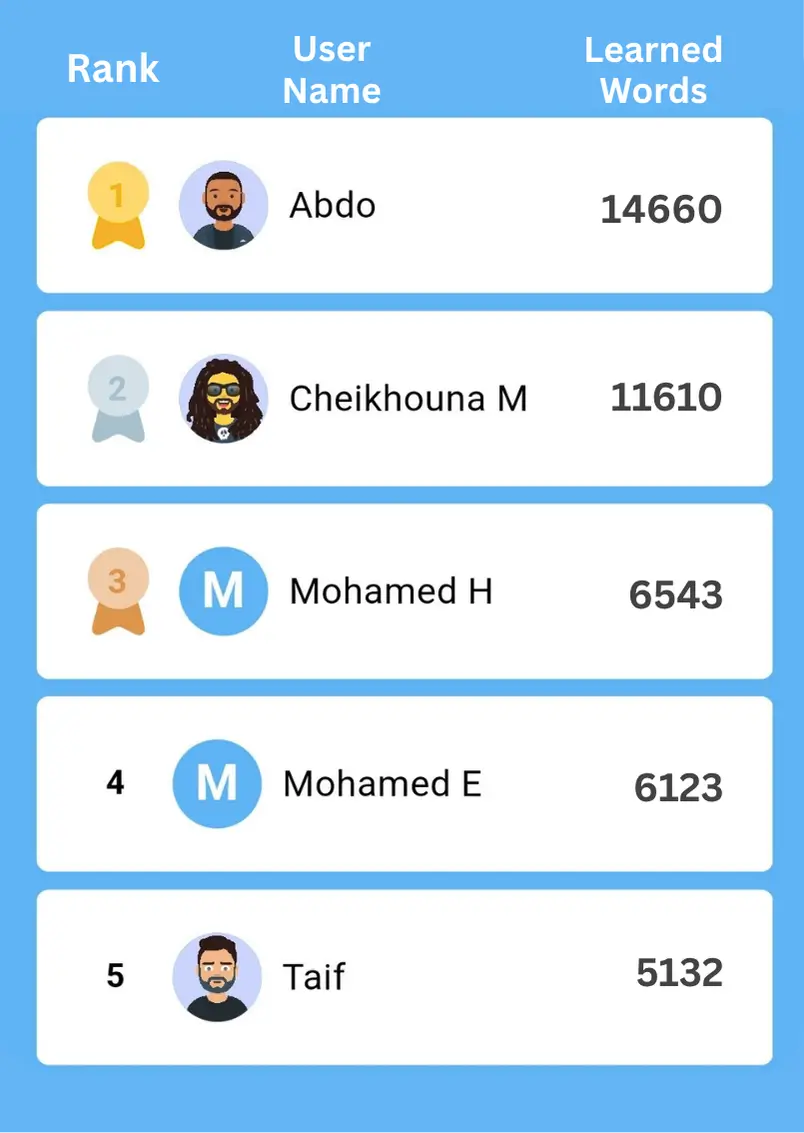
🥇 1st Place: 14,660 words memorized
🥈 2nd Place: 11,610 words memorized
🥉 3rd Place: 6,543 words memorized
Lingedia Is an Ecosystem, Not a Flashcard App
Anki is great for memorizing facts. Lingedia is built for mastering English.
- Dictionary: Oxford, Collins, and YouTube examples
- Speaking Coach: Shadowing tools with adjustable speed
- Vocabulary Builder: Works for all levels
Anki vs. Lingedia at a Glance
Anki
- Manual card creation
- Passive recognition
- Self‑grading
- Deck management
- Text‑only learning
- No pronunciation training
Lingedia
- Instant word capture
- Active speaking/listening/writing
- Automatic grading
- Real‑world content
- Audio + examples
- Built‑in pronunciation training
Try Lingedia for Your Next 100 Words
Don’t delete Anki. Just stop adding new cards and let Lingedia handle your next 100 words. See which app you actually open every day.
Start with Lingedia

Want to know more? Learn more about the Lingedia app
Not sure where your English stands? Take our vocabulary test
Share