
How many words does a native speaker actually know? At what age does your vocabulary stop growing? And does living in an English-speaking country really make you fluent?
Most language advice is based on feelings. We decided to rely on data.
We analyzed 169,550 verified results from the Lingedia Vocabulary Size Test. We wanted to map the exact path of English learning from age 10 to 60+. The results reveal a massive “Native Gap,” a clear “Education Ladder,” and a universal “Age Wall” that stops most learners completely.
Here is what the data says—and how you can beat the odds.
- The 6,600-Word Gap: There is a massive divide between the average learner (8,448 words) and native speakers (15,106 words).
- The Age 25 Wall: Without active study, English vocabulary growth for both groups typically flatlines at age 25.
- The Immersion Myth: Moving to an English-speaking country only adds 1,566 words, leaving a significant 5,810-word gap. Immersion alone is not enough to reach native-level fluency.
Table of Contents
The Methodology: How We Measured It
To ensure scientific accuracy, we didn’t just use a simple multiple-choice quiz. We analyzed data using the Lingedia Adaptive Engine, which tests users against a database of the 19,300 most common English headwords.
(A headword is the base or root form of a word. For example, “complete” is tested as a headword, but variations like “completely” or “completed” are not counted as separate words).
The test adjusts the difficulty in real-time. It also uses “ghost words” (fake, made-up words) to catch people who are randomly guessing. This allowed us to find the precise “Vocabulary Ceiling” for thousands of learners worldwide.
Finding 1: The Native Gap is Exactly 6,600 Words
The main question for any learner is: “How far behind am I?” The data gives us a clear, serious answer.
- 🗣️ Average Native Speaker: 15,106 words
- 🌍 Average Non-Native Learner: 8,448 words
Finding 2: The “PhD Advantage”
Does more university education mean a larger vocabulary? Yes. We tracked vocabulary growth through the education system, and the results show that formal study continues to build vocabulary at every single level.
| Study Level | Native Speakers | Non-Native Learners |
|---|---|---|
| High School | 14,149 | 7,053 |
| Bachelor’s | 15,739 | 8,878 |
| Master’s | 16,448 | 10,844 |
| PhD (Peak) | 16,816 | 11,786 |
The Insight: As expected, formal education steadily pushes vocabulary higher. There is no “ceiling” here. PhD students have the highest vocabulary of all. This supports the idea that active, intense study works. While many people stop learning after their Bachelor’s degree, PhD students continue reading complex texts, and their vocabulary keeps growing because of it.
Finding 3: The “Age 25” Wall
This was our most important discovery. When we looked at vocabulary size by age (outside of academia), both natives and learners hit a wall at the exact same time.
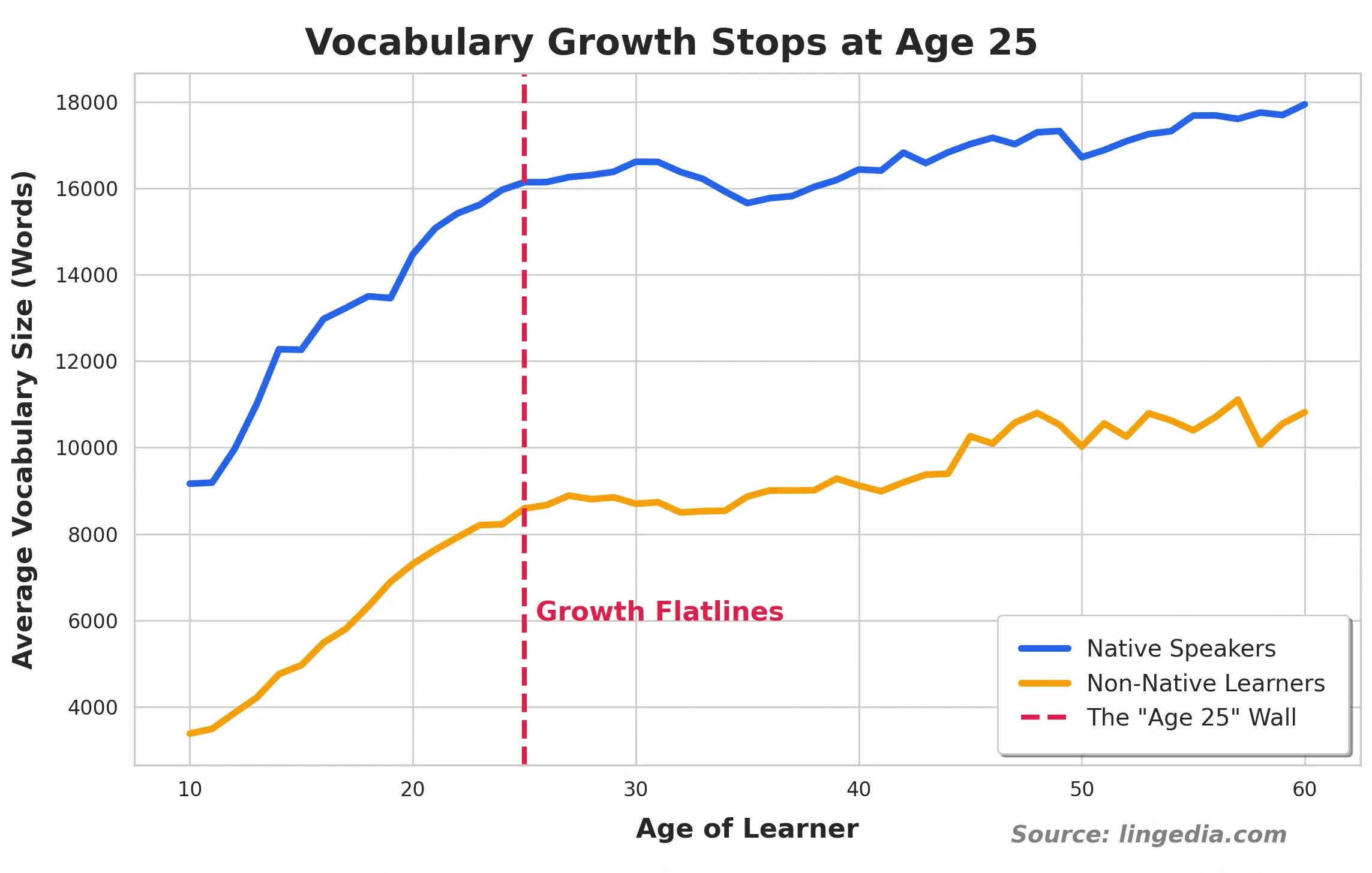
- Natives: Growth stops at Age 25.
- Learners: Growth stops at Age 25.
The “Real World” Effect: For most people, active learning stops when school stops. Once you start working, you stop studying. You start repeating the same basic Business English every day, and your vocabulary growth flatlines.
Finding 4: The “Immersion Myth”
Does moving to an English-speaking country automatically make you fluent? We separated non-native learners based on their current country of residence (e.g., the US, UK, Canada) to see if daily immersion closes the gap.
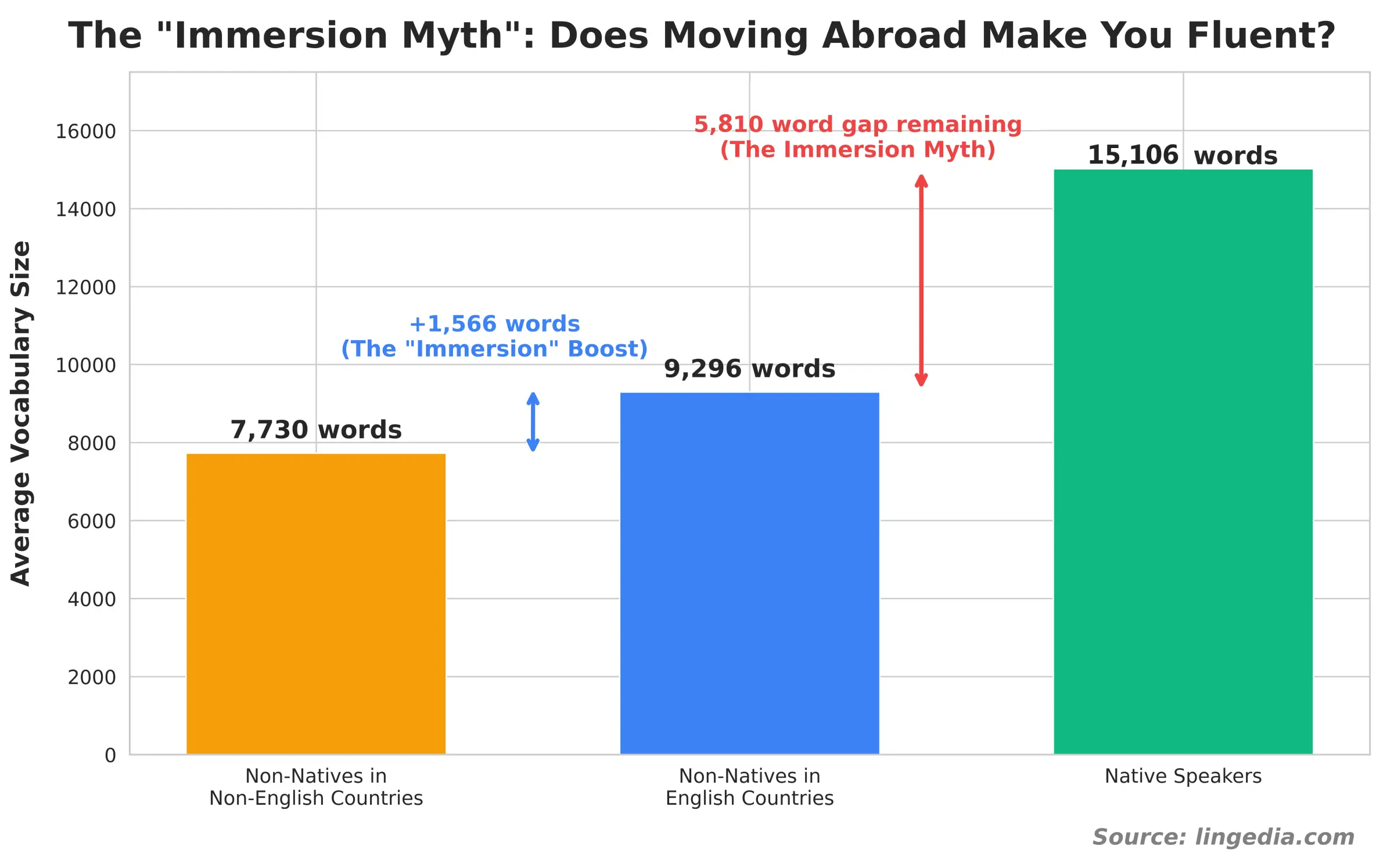
- Learners in Non-English Countries: 7,730 words
- Learners in English-Speaking Countries: 9,296 words
The Insight: Moving abroad gives you a solid boost of about 1,500 words. You naturally learn the vocabulary required to survive: renting an apartment, opening a bank account, and navigating the grocery store.
However, the data destroys the “immersion myth.” Even after moving abroad, these learners are still over 5,300 words behind their native-speaking neighbors.
This proves that passive listening is not enough. You cannot absorb an advanced vocabulary just by hearing native speakers talk at the office or on the subway. Your brain only remembers the words it actively needs to use. Once you learn enough English to survive your daily routine, your vocabulary growth stops, regardless of what country you live in.
The Solution: How to Break the Wall
This is why we built the Lingedia English Vocabulary Builder. It’s not just another English vocabulary app; it uses a smart Automated Spaced Repetition (SRS) algorithm designed to hack the “Forgetting Curve.”
While there are many SRS apps like Anki, they have three main problems: they are exhausting, passive, and inaccurate.
We fixed all three. Lingedia replaces the traditional “flip-and-guess” flashcard with a Spaced Repetition Smart Quiz. To pass a review, the algorithm forces you into active production:
- 🎙️ Speaking: You must speak the word into your microphone to build physical muscle memory.
- 🎧 Listening: You must identify the native pronunciation by ear.
- ⌨️ Typing: You must type the word with perfect spelling accuracy.
(Curious how this active method compares to traditional tools? Read our comparison, The Best Way to Memorize Vocabulary: Anki vs. Lingedia)
Our app has proven its effectiveness, and our users have learned thousands of words to shatter their vocabulary ceilings.
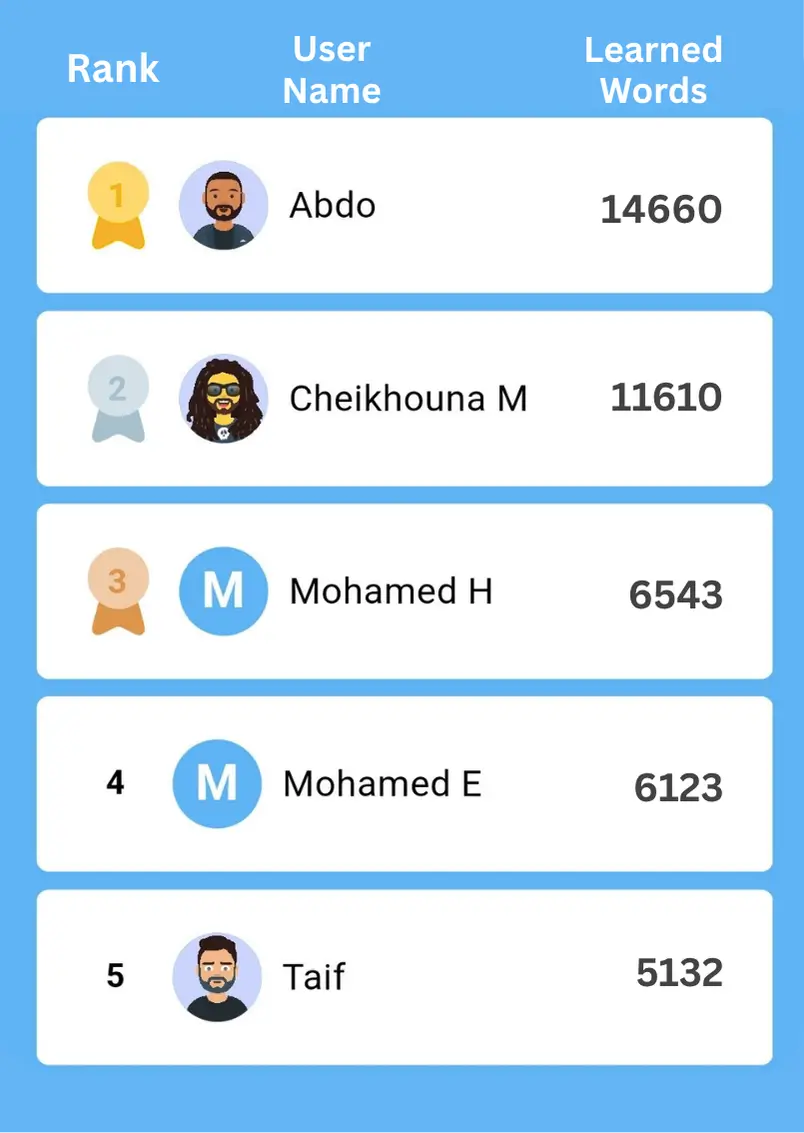
By combining effortless input with this intense, automated active output, our data shows that users practicing for just 15 minutes a day can shatter the Age 25 Wall and start growing their vocabulary again.
What is your exact number?
Take the official 5-minute Vocabulary Size Test to find out exactly where you stand on the 6,600-word gap.
Take the Free Vocabulary TestWant to increase your vocabulary? Get the Lingedia App


Share